 Go back
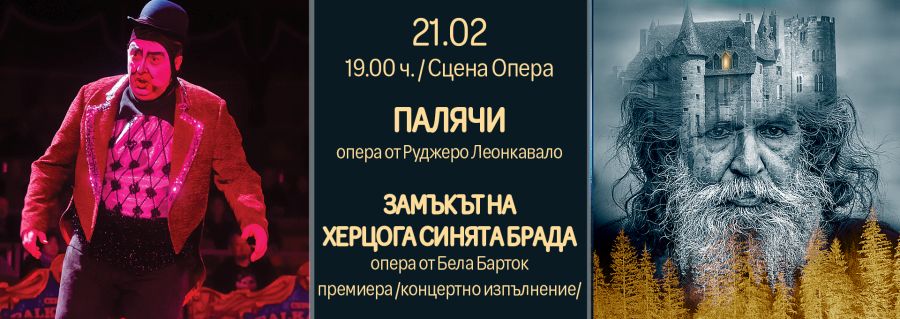
Performed in concert for the first time on February 21, 2019.
Soloists Alexander Krunev, Petya Petrova
Stara Zagora State Opera Orchestra
"The Castle of the Duke Bluebeard (Hungarian: A kékszakállú herceg vára) is an opera by Hungarian composer Béla Bartók, based on the fairy tale Bluebeard by Charles Perrault, with a libretto by Béla Balázs. The opera is in just one act with a duration of just over an hour and two actors, Bluebeard and his wife Judith. Composed in 1911 it was edited several times in the following years, it was first staged on 24 May 1918 at the Royal Opera House in Budapest.
First performance in Bulgaria: 10 February 1975, Sofia.
Actors:
Duke Bluebeard - bass
Judith - mezzo-soprano
The Duke's previous wives - without singing
Place and time of action: the castle of the Duke of Bluebeard, Middle Ages.
Duke Bluebeard introduces his new wife in a gloomy hall of his castle. Judith has abandoned her parents, brothers and fiancé for the man she loves. She is not afraid of the terrible stories people tell about the Duke. Judith is in love and is willing to do anything for Bluebeard. In the hall the maiden sees seven iron doors and wants to know what lies behind them. Her husband warns her, "You'd better not ask that. The doors hide terrible secrets!" Finally, he gives in to her pleas. Behind the first door is a torture chamber, behind the second an armoury, behind the third treasure chests, behind the fourth a magnificent secret garden, behind the fifth the Duke's domain is visible.
The gloomy hall grows brighter. Bluebeard offers all his lands, riches and treasures to Judith, only asking her for one thing - to give up her desire to see the last two rooms. But his young wife's curiosity is overwhelming and he relents. Behind the sixth door, Judith sees a still lake of tears. She begins to question her husband about his previous wives and looks anxiously at the seventh door. Guessing that the answer to Bluebeard's family life lies there, Judith insists on the seventh key. Bluebeard opens the last door, and his three previous wives emerge from it, wearing expensive robes and crowns on their heads. The Duke has received all his riches from their dowries. He met his first wife one morning - so every morning now belongs to her. The second wife he met at noonday - and to her now belongs his every noonday. He met the third wife one evening - now every evening of his belongs to her. For Judith, all the Duke's nights remain... and a diamond crown. The maiden shudders in horror. She begs Bluebeard for mercy, but the Duke drapes an expensive robe over her, puts a crown on her head, and Judith, bowed by the weight of the jewels, follows the other three women and enters the seventh room. The door closes, darkness descends once more upon the castle. The night comes, which for Judith will be eternal.
HISTORY OF THE WORK
The plot of this opera is based on a legend of French origin. It was also retold by the great French storyteller and beloved children's writer Charles Perrault in his collection, The Tales of My Mother Goose. In Perrault's retelling of the legend, the knight Raoul kills his six wives because they dared to peek into a locked room and thereby broke the knight's ban. This plot has passed into other nations. In Hungary there is a folk-balladq akin to the French, which tells of the baron seducer who killed his three wives and then tricked the most famous beauty.
The legend of Bluebeard has been used by many artists in various kinds of art. As early as the 1970s, Jacques Offenbach wrote the operetta Bluebeard, which gained wide popularity and is still performed today. The great Belgian symbolist poet and playwright Maurice Maeterling completed his drama Ariane and the Bluebeard in 1904. Just three years after that, the French composer Paul Ducasse (1865-1935) wrote his opera of the same name based on this title. Later, composer Emil Reznicek would write an opera, The Bluebeard Knight, which was performed in 1920 and remained in the repertoire of theatres for far too long.
The young Hungarian poet, playwright and director Béla Balázs (1884-1949) wrote his poem The Castle of the Duke Bluebeard in 1910 and dedicated it to his two friends Béla Bartók and Zoltán Kodály. Balazs' poem is in fact a new version of Maurice Maeterling's tragedy, with the author incorporating new elements from the Hungarian folk ballad
The plot of the poem appeals to Béla Bartók above all for its poeticism and strong dramatic quality. The composer wrote his music in just a few months. However, the management of the Budapest Opera refused to include Bartók's work in the repertoire. A few years later, after the great success of Béla Bartók's first ballet The Wooden Prince in 1917, the opera management decided to stage The Castle of the Duke Bluebeard as well. Thus, seven years after its completion, the opera was performed for the first time in Budapest on 24 May 1918 under the conductorship of the Italian Edgisto Tango. After the premiere, Béla Bartók remarked: 'After the success of my opera, the attitude of the Hungarian public towards my music changed dramatically'.
MUSIC
The year 1911 was remarkable in Béla Bartók's artistic development. In this year, the 30-year-old composer created two of his most valuable works, the operas The Castle of the Duke Bluebeard and Allegro barbaro (Barbarous Allegro
)Having freed himself from the influences of his youth, Béla Bartók shows exceptional creative identity in these works and especially in his operas. With his opera Bluebeard's Castle, Bartók opened up new avenues of development for opera and, through his two ballets, The Wooden Prince and The Marvellous Mandarin, for ballet as well. The music of his opera is written with extremely high professional skill is with bold and innovative means of expression. This music is deeply national in character, possessing brilliant colour and stirring emotional power. In Bartók's opera new stylistic features, more distinctive ideological and aesthetic concepts and a perfect organization of the musical material are revealed.
"The Duke's Castle Bluebeard is not written in traditional operatic form, but in instrumental form. In fact, it is a large rondo consisting of an introduction (prologue), seven episodes and a coda (epilogue). In the short prologue, a reader delivers the opening lines of Bela Balazs's poem against a sombre symphonic introduction. Music and text, united in mood, introduce the listener to the atmosphere of the action to come. This is followed by the exposition of the seven episodes, also corresponding in spirit and character to The Duke's Seven Secrets. The music is predominantly sombre in character, but there are also illuminations. Several leitmotifs unify the musical development. One of the main ones is that of blood, which is entrusted to the brass instruments. In the first part of the opera, the poetic image of Judith is predominant, with strong love and femininity to the fore. The second half of the work is dominated by the image of the Duke. He is the epitome of masculinity, but expressed in its crudest and cruellest form.
The music is indeed dominated by sombre colours, but there are also a number of lyrical moments. These bring great variety throughout the opera and emotional polyphony to the seven episodes. It should also be noted that the spirit of Hungarian folk song is clearly felt in the music. Creatively reinterpreted, it makes good use of the balladic melodies of the desert. The fourth and fifth episodes, 'The Magic Garden' and 'The Duke's Domain', are the most luminous and lyrically rich. The sixth and seventh are executed with particularly strong dramatic intensity, verging on the tragic. Bartok achieves all this while strictly adhering to the spirit of Bela Balazs' work, even using the poem without any alterations to the text.
The vocal parts of the two protagonists are constructed in a sharp and highly broken melodic line. They represent a psychological dialogue saturated with strong expression. In the recitatives, written with great plasticity and flexibility, the character of Hungarian narrative folk songs is felt particularly clearly. Examining the work, the scholar of Bartok's oeuvre, the Hungarian musicologist Bence Szabolczy, points out that the composer "paints in allegorical form his contemporary reality (the years immediately before the First World War) and immerses the audience in the poetry of the distant past..."
Source. Book on Opera, Fourth supplemented and revised edition, State Publishing House "Music", Sofia, 1983